What Does an Echocardiogram Show About Your Heart Health?
Chest discomfort, breathlessness, palpitations, unexplained fatigue, or dizziness can sometimes be signs of an underlying heart condition. An echocardiogram is one of the most effective tests used to examine the heart’s structure and function in detail. This non-invasive heart ultrasound provides valuable information about your heart’s pumping efficiency, valvular function, blood flow, and any abnormalities that may require further monitoring or treatment.
This article explains what an echocardiogram shows, how accurate it is, the different types of echocardiograms, and their purposes.
Don’t Wait Weeks for Answers
Get fast, specialist-led heart checks with same-day or quick appointments
What is an Echocardiogram?
An echocardiogram, often called an echo or heart ultrasound, is an important diagnostic test that uses sound waves to create real-time images of the heart’s structure and function. It is completely safe and painless, and is usually performed to identify the root cause of your symptoms, such as chest pain, breathlessness, and palpitations.
How is it Performed?
During an echocardiogram, a handheld device called a transducer is moved over your chest (transthoracic echo) to analyse your heart, or a small probe is guided into the oesophagus (transoesophageal echocardiogram) to evaluate your heart from a different angle and view your aorta (main artery to your heart).
The transducer emits high-frequency sound waves that bounce off your heart and blood vessels. These sound waves transmit 3D, real-time images on the computer monitor, which your cardiologist later examines and interprets.
Different Types of Echocardiograms and Their Purposes
2D and 3D Echocardiography
Two-dimensional (2D) and 3-dimensional (3D) echocardiography are heart imaging techniques that provide real-time views of the heart’s structure and function. These scans help analyse the heart chambers, valves, muscle function, and overall pumping ability. A 3D echocardiogram offers more detailed insights than standard 2D imaging.
M-Mode Echocardiography (Motion Mode)
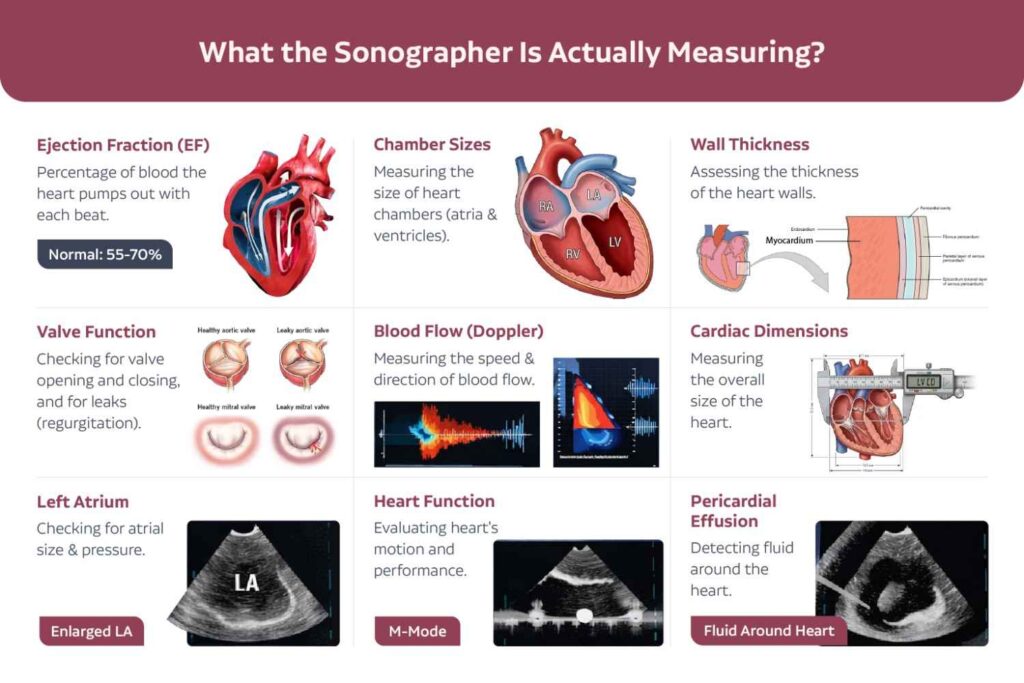
M-mode echocardiogram provides a one-dimensional real-time view of the heart, showing tissue interfaces along a narrow line. It displays myocardial motion to provide accurate and real-time measurements of wall thickness, internal diameter, and heart rate.
Doppler Echocardiography
A Doppler echocardiogram is an advanced ultrasound technique used to check the blood flow through the heart chambers, valves, and blood vessels. It helps identify abnormalities in blood circulation, including narrowed or leaky valves and areas of turbulent or restricted blood flow.
What Does an Echocardiogram Show?
An echocardiogram provides detailed insights into the heart’s chambers, valves, and muscles, as well as monitors blood flow to detect any blockages. Here we explain what an echocardiogram can reveal about your heart health:
Heart Size and Shape
A heart ultrasound shows the size and shape of the heart chambers and muscle, and whether the chambers are enlarged or the heart muscle has thickened due to conditions such as high blood pressure, cardiomyopathy, or long-term cardiac strain.
Heart Pumping Function
One of the most important uses of an echocardiogram is to analyse the heart’s pumping efficiency. It is used to measure the ejection fraction – an indication of how much blood leaves the heart with each heartbeat. Reduced pumping function may suggest heart damage or weakening of the cardiac muscles.
Structural Heart Abnormalities
An echocardiogram can detect structural abnormalities present from birth or developed later in life. These may include congenital heart defects, a hole in the heart, valvular heart disease, septal defects, or abnormal chamber connections.
Blood Flow Through the Heart
Using Doppler ultrasound technology, an echocardiogram can evaluate the blood flow through the heart chambers and valves to identify abnormal, restricted, or reversed blood flow.
Fluid Around the Heart
An echocardiogram can detect excess fluid between the heart and the pericardium, a condition known as pericardial effusion. An infection, inflammation, or autoimmune disease can cause this condition.
Signs of Previous Heart Damage
The echocardiogram can also identify the weakened or scarred areas of the heart muscle, which can be signs of a previous heart attack.
Which Conditions Can be Diagnosed With an Echocardiogram?
An echocardiogram is often done to diagnose and assess the following conditions:
- Enlarged heart chambers
- Cardiomyopathy
- Heart Failure
- Atrial Fibrillation
- Congenital heart disease
- Pericardial Effusion
- Heart valve disease
- Aortic abnormalities
- Previous heart attack
Explore Heart Conditions Our Specialists Treat
What Can a Heart Echo Miss?
Despite its effectiveness, an echocardiogram does have some limitations. It may not always provide a complete picture of heart health. Factors such as extra tissues in the body, caused by obesity or lung disease, can affect the image quality. Small tumours or masses in the heart can also be neglected in an echocardiogram. Additionally, very small abnormalities, such as tumours, clots, or early structural changes within the heart, may be difficult to identify on a standard echocardiogram.
What Can an Echo Detect that an ECG Cannot?
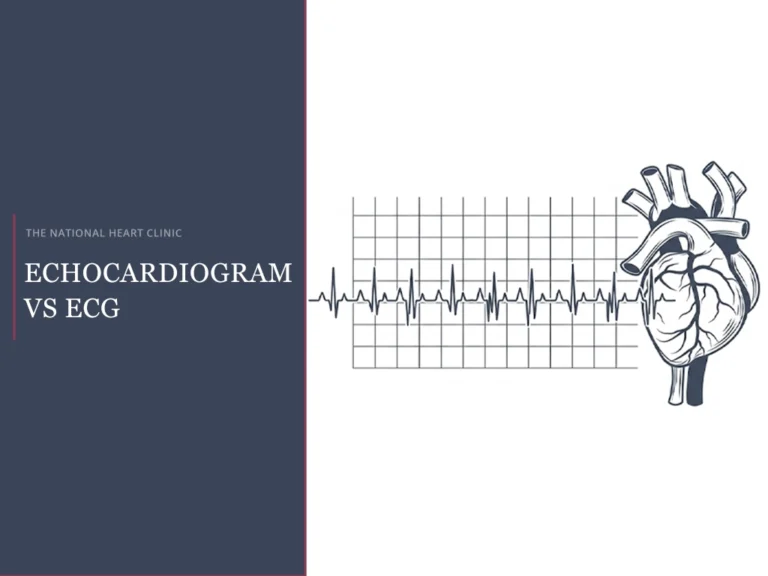
An ECG and an echocardiogram are essential heart tests, but they provide different kinds of information. An electrocardiogram (ECG) records the electrical activity of the heart, whereas an echo provides complete insights into its structure and function. An echocardiogram can detect structural abnormalities of the heart, like issues with cardiac size, shape, and pumping efficiency.
It also provides detailed information about how well the heart valves are opening and closing, helping to identify conditions such as valve leakage or narrowing. In addition, an echo can detect fluid around the heart and congenital heart defects. These findings are not visible on an ECG.
Can a Heart Echo Detect Blocked Arteries?
Although an echocardiogram can’t directly visualise blocked coronary arteries, it provides valuable insights into the heart’s structure, pumping efficiency, and blood flow patterns that can help detect restricted blood supply. In some cases, a stress echocardiogram may be recommended to identify areas that may not be receiving enough blood due to narrowed or blocked arteries.
How Accurate is an Echocardiogram?
Echocardiograms are considered highly accurate and reliable for evaluating the heart’s structure and function. However, the accuracy can sometimes be affected by obesity, arrhythmia, or poor image quality, and additional investigations may be recommended to confirm findings.
Learn More About the Accuracy of an Echocardiogram
Bottom Line
If you want to know more about the test or are unsure whether an echocardiogram is the right scan for you, contact our team at The National Heart Clinic, Harley Street, London, or use online booking to reserve a time to see our specialists.
Disclaimer
The information provided in this blog is for general information and educational purposes only. The content is not intended to be a substitute for professional medical advice, diagnosis, or treatment. Always seek the advice of your GP or a qualified medical professional regarding any medical condition. If you are experiencing a medical emergency, please contact emergency services immediately.