Treadmill Stress Test vs Stress Echo: What’s the Difference?
A treadmill stress test and a stress echocardiogram are both cardiac stress tests, used to evaluate blood flow to the heart and detect any reduced blood flow caused by blocked or narrowed coronary arteries. Your doctor may recommend one or both of these tests to see how well your heart works under physical strain and to find the cause of symptoms such as breathlessness, chest pain, palpitations, or dizziness.
In this guide, we explain the key differences between a stress test and a stress echo: how each is performed, what they can detect, and when you might need one.
What is a Treadmill Stress Test?
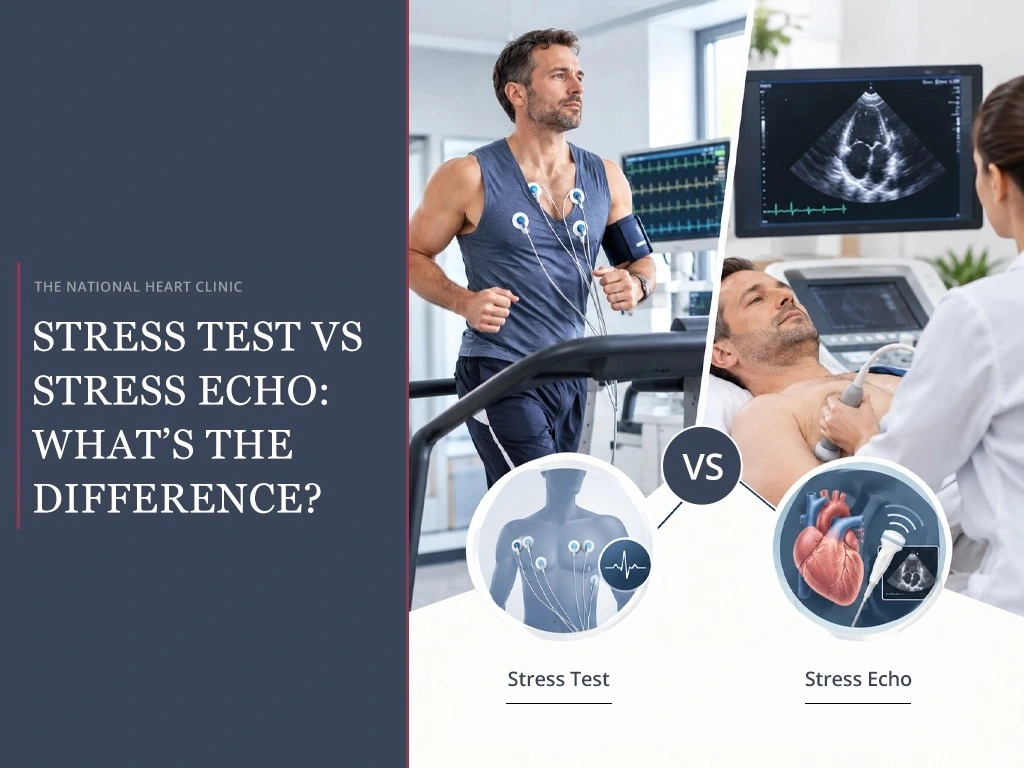
A treadmill stress test, also known as an exercise tolerance test or exercise ECG, shows how your heart responds to physical exertion. You walk on a treadmill or pedal a stationary bike while your doctor monitors your heart’s electrical activity through an electrocardiogram (ECG).
Book Your Treadmill Stress Test
What Can a Treadmill Stress Test Evaluate?
- Changes in your heart’s electrical activity during exercise
- How well your heart responds to physical exertion
- Your exercise tolerance
- The possible cause of symptoms such as chest discomfort, breathlessness, or dizziness
How to Prepare for an Exercise Stress Test?
- Do not eat or drink for a few hours before the test.
- Wear loose, comfortable clothing and sturdy shoes.
- Avoid caffeine, including tea, coffee, and energy drinks, for around 24 hours beforehand.
- Avoid smoking and tobacco.
- Discuss your medication with your GP or cardiologist, and only stop the medicine if your doctor advises it.
- Try to stay calm, as anxiety can affect your results.
How is an Exercise Stress Test Performed?
Before the test, a technician records your vital signs, including your blood pressure and resting heart rate. Small sticky electrodes are then attached to your chest and arms and connected to an ECG machine.
You will be asked to start walking on the treadmill or pedalling the bike. On a treadmill, the speed and incline increase gradually every 3 minutes. Your heart rate, ECG and general condition are monitored closely throughout.
The technician will stop the test once you reach your target heart rate, or sooner if you cannot continue because of extreme tiredness, chest pain, or breathlessness.
Also Read: Ways to slow down heart rate naturally
When Might a Stress Test Not be Recommended?
Doctors may not recommend cardiac stress testing if you have any of the following heart conditions:
- An abnormal heart rhythm.
- Ongoing chest pain
- Inflammation of the heart muscle
- Severe aortic stenosis
- Aortic dissection
- A recent heart attack
What is a Stress Echocardiogram?
A stress echocardiogram, or stress echo, is a heart ultrasound that shows how your heart functions under physical exertion. It combines a standard echocardiogram (ultrasound imaging of the heart) with an exercise stress test, so your doctor can see your heart’s structure and movement as well as its electrical activity.
Book Your Exercise Stress Echo
What Can a Stress Echo Evaluate?
A stress echocardiogram helps assess how efficiently your heart pumps blood during exercise. It can help detect the underlying cause of:
- Chest pain or discomfort
- Irregular heartbeat
- Breathlessness
- Dizziness or lightheadedness
Know More: Exercise-Induced Heart Problems
How to Prepare for Stress Echocardiography?
- Don’t eat or drink anything for a few hours before the test
- Wear loose, comfortable clothes and sturdy shoes.
- Avoid caffeine, including tea, coffee, and energy drinks, for 24 hours beforehand.
- Follow your healthcare provider’s medication instructions, and don’t stop any routine medicine without consulting your doctor.
- Don’t stop or use tobacco on the day of the test.
- Try to stay calm, as stress and anxiety can affect your results.
How is a Stress Echo Performed?
Small sticky electrodes are attached to your chest and connected to an ECG machine. Before you exercise, your sonographer records a resting ECG and echocardiogram.
You will then walk on a treadmill or pedal a stationary bike. On a treadmill, the speed and incline increase gradually every 3 minutes, and you continue until you reach your target heart rate. The technician may stop the test earlier if you develop symptoms such as chest pain, breathlessness, dizziness, or extreme exertion.
Learn About: Tilt Table Test
Exercise Stress Test vs Stress Echo: A Quick Comparison
| Treadmill Stress Test | Stress Echocardiogram | |
| What it Records? | Heart’s electrical activity | ECG and ultrasound images of the heart before and after exercise |
| Preparation | A few hours of fasting, no caffeine or smoking for 24 hours, wear comfortable clothes and sturdy shoes. | Same as for stress ECG, and follow your doctor’s medication advice. |
| When it is ordered? | To identify the underlying cause of chest pain or breathlessness, or to check exercise capacity and monitor known heart conditions | When the exercise ECG is unclear or abnormal, or when your cardiologist needs more detail about blood flow and heart function |
| Duration | Around 30 minutes | Around 45-60 minutes, including imaging before and after exercise |
Do You Need a Stress Echo or a Treadmill Stress Test?
Which stress test you need depends on your symptoms, medical history, and what your doctor wants to investigate. A stress echo adds ultrasound imaging, which gives more detail about how your heart pumps. Your cardiologist will choose the right test for you.
Get Your Cardiac Stress Test at The National Heart Clinic
Don’t wait for the symptoms to become severe. Schedule an appointment with a cardiologist or book a stress test if you experience unexplained fatigue, breathlessness, frequent episodes of dizziness or fainting, especially if these symptoms appear with physical exertion.
At The National Heart Clinic, our experienced cardiology team offers treadmill stress tests, stress echocardiograms, and a full range of heart investigations, with clear results and a personalised plan explained by a specialist.
Conclusion
Both the treadmill stress test (exercise tolerance test) and the stress echocardiogram help your cardiologist see how your heart performs under physical strain. Which test you need depends on your symptoms, medical history, and risk factors, and a specialist can guide that choice. Don’t ignore chest pain, breathlessness, palpitations or dizziness.
Early testing can identify problems with blood flow to the heart before they become serious. Book your cardiac stress test today at The National Heart Clinic or call +44 7957 534 391 to speak to our team with any queries.
Disclaimer
The information provided in this blog is for general information and educational purposes only. The content is not intended to be a substitute for professional medical advice, diagnosis, or treatment. Always seek the advice of your GP or a qualified medical professional regarding any medical condition. If you are experiencing a medical emergency, please contact emergency services immediately.
Share with Others: