
What is Tilt Table Test? How It Works, and When It Is Used
Do you get dizzy or lightheaded when you stand up or jump up quickly? That could be caused by weakness or may be a sign of a nervous system disorder, such as vasovagal syncope, postural orthostatic tachycardia syndrome (POTS), and orthostatic hypotension. A Tilt Table Test is an excellent way to evaluate blood pressure and heart rate response to a change in posture and understand how your autonomic nervous system behaves while changing your body position.
What is a Tilt Table Test?
A tilt table test, also known as head-up tilt table (HUTT) testing, is a procedure performed to determine the underlying cause of dizziness or fainting with position changes – usually while standing up. It helps doctors diagnose or manage orthostatic hypotension, POTS, and vasovagal syncope.
Learn More About Diagnostic Cardiology
What Symptoms Can a Tilt Table Test Assess?
A tilt table test may be recommended if you experience one or more of the following symptoms:

- Dizziness or lightheadedness
- Fainting or near-fainting episodes
- Palpitations while standing up
- Weakness, fatigue, or difficulty concentrating while standing upright
- Breathlessness on standing
- Visual changes such as tunnel vision or ‘seeing stars’
- Symptoms triggered by standing, emotional stress, or heat
Why is a Tilt Table Test Done?
A tilt table test is usually advised if a patient faints multiple times without a clear reason. It may help doctors diagnose or manage:
Orthostatic Hypotension
A sudden and significant drop in blood pressure on standing up. The quick drop in BP may cause dizziness or fainting.
Vasovagal Syncope
A brief loss of consciousness, commonly called fainting, due to a sudden drop in blood pressure and heart rate caused by stress, fatigue, or other medical reasons.
Postural Orthostatic Tachycardia Syndrome (POTS)
The irregular and fast heartbeat that occurs when standing up and can lead to fainting or other symptoms.
How is the Tilt Table Test Performed?
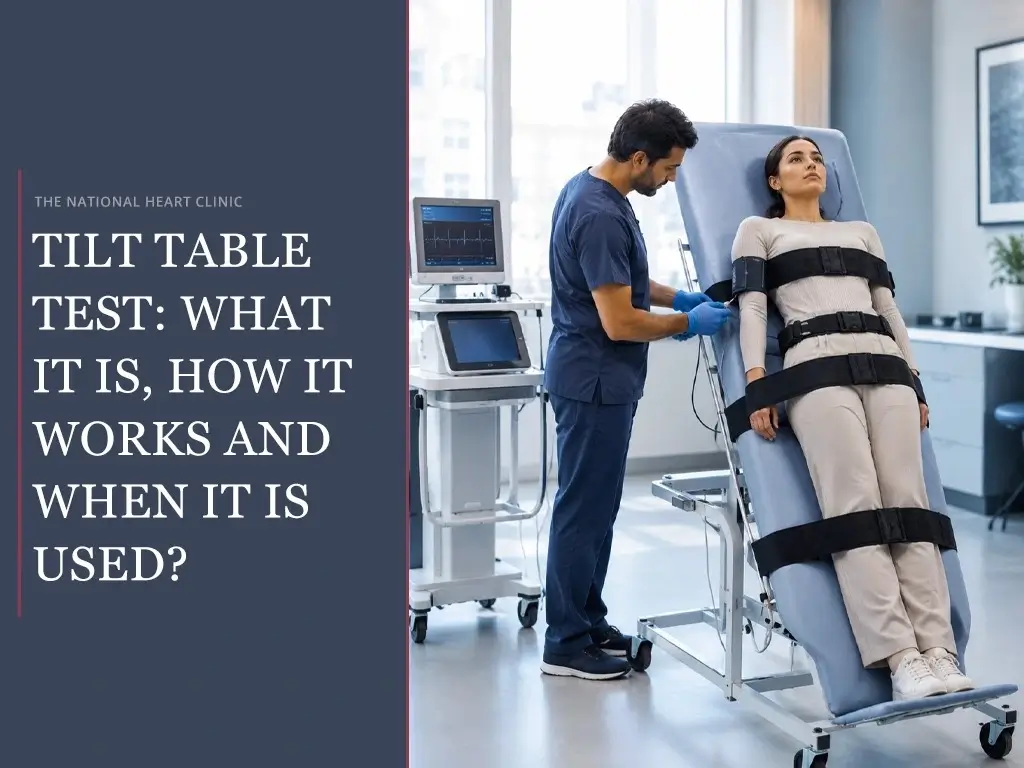
During a tilt table test, you are securely strapped to an examination couch that slowly tilts from a lying to an upright position. The purpose of tilting is to monitor your symptoms, such as blood pressure and heartbeat, in a safe environment.
Before the test begins, a blood pressure cuff is placed around your arm, and ECG electrodes are attached to monitor your heart’s electrical activity.
What Happens During the Test?
- You lie flat on the table for around 10 minutes while your blood pressure, heart rate, and heart rhythm are monitored.
- After that, your provider tilts the examination couch upward to an almost standing position (around a 70-degree angle) in around 10 seconds.
- You remain in this upright position for around 45 minutes, during which your blood pressure and heart rate are monitored regularly, and you will be asked about any symptoms you experience.
- If you experience noticeable symptoms, like fainting, during the test, the table may be returned to a flat position, and the test may be stopped. Most people who faint during the test wake up again almost right away.
Are There Any Preparations Required?
You should follow your healthcare provider’s instructions before having a tilt table test. Avoid caffeine and alcohol for 12 hours and fast for at least 2 hours before the test. Don’t smoke or use nicotine on the day of your tilt table testing. Take or avoid medication as instructed by your doctor. You may need to avoid driving right away after the test, especially if you feel dizzy or faint.
Tilt Table Test Results: What Do They Mean?
Tilt table test results show how your blood pressure and heart rate respond when you move from lying down to an upright position. Your healthcare provider will consider these changes alongside any symptoms you experience during the test to interpret the results.
Positive Tilt Table Test
A positive result means that the test showed an abnormal response to the change in position. Depending on the condition being investigated, this may include:
- A significant drop in blood pressure, which may be associated with orthostatic hypotension or vasovagal syncope.
- A noticeable increase in heart rate, which can be an indication of postural orthostatic tachycardia syndrome (POTS).
- Symptoms such as dizziness, lightheadedness, nausea, or fainting during the test.
Negative Tilt Table Test Result
A negative result means that no significant abnormal response was detected during the test. Your blood pressure and heart rate remain within an expected range, and you do not develop significant symptoms such as dizziness or fainting.
A negative result does not always rule out every possible cause of your symptoms. Your healthcare provider will interpret the results together with your symptoms, medical history, and any other test findings.
Explore our cardiac tests and investigations
Possible Risks or Complications
Tilt table testing may have the following risks depending on your medical condition:
- Low or high blood pressure
- Palpitations or change in heart rate
- Dizziness
- Headache
- Nausea
- Fainting or near fainting
Conclusion
A tilt table test can help assess how your heart rate and blood pressure respond to changes in position, particularly when investigating dizziness, fainting, or unexplained changes in heart rate. Results are interpreted alongside your symptoms and medical history to determine the most appropriate next steps. If you are experiencing unexplained symptoms, book a consultation with one of our experienced cardiologists for a comprehensive assessment and personalised advice. Same-day diagnostics and online consultations are available.
Disclaimer
The information provided in this blog is for general information and educational purposes only. The content is not intended to be a substitute for professional medical advice, diagnosis, or treatment. Always seek the advice of your GP or a qualified medical professional regarding any medical condition. If you are experiencing a medical emergency, please contact emergency services immediately.